Categories
Courses Categories
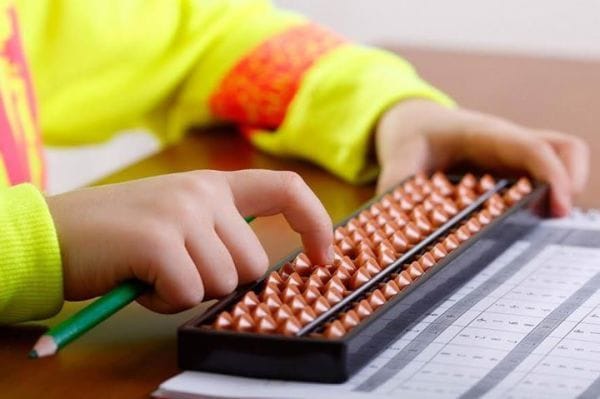
Abacus Class
Learn math the ancient way, with modern benefits!
An abacus is a simple, ancient tool used for counting and performing arithmetic operations. It consists of a series of rods or wires, each holding beads that can be moved back and forth. The beads are typically divided into groups, representing different place values (like ones, tens, hundreds). By sliding the beads, users can perform addition, subtraction, multiplication, and division. It was widely used in various cultures before the advent of modern calculators.
The abacus dates back thousands of years, with evidence of its use in ancient Mesopotamia (around 2300 BCE) and ancient China (around 500 BCE). It was also used in Greece, Rome, Egypt, and Japan.
The device was an essential tool for merchants, traders, and accountants to perform complex calculations before the invention of the modern calculator.
The traditional abacus consists of rods or wires, each representing a specific place value (ones, tens, hundreds, etc.).
Beads are placed on these rods, and they are moved to represent numbers or values. Typically, there are two kinds of beads:
- Upper beads (often representing 5 units each).
- Lower beads (usually representing 1 unit each).
Types of Abacus
Chinese Abacus (Suanpan)
Has two beads in the upper section and five beads in the lower section on each rod.
Each rod represents a place value, and you can perform addition, subtraction, multiplication, and division.
Japanese Abacus (Soroban)
Similar to the Chinese abacus but typically has one bead in the upper section and four beads in the lower section.
It's more streamlined for faster calculations and is still widely taught in Japan.
Roman Abacus
Consisted of a flat board with grooves and movable counters or pebbles to represent numbers. It was primarily used for arithmetic in ancient Rome.
Russian Abacus (Schoty)
Features a frame with ten rods, each with ten beads, arranged differently from other types, and was used for addition and subtraction.
How It Works
- The position of the beads represents numbers. For example, in the Chinese-style abacus, moving a bead to the top row (upper beads) represents 5 units, and moving a bead to the lower row represents 1 unit.
- The beads are manipulated in a "place-value" system, similar to how numbers are written today (ones, tens, hundreds, etc.).
- You can add, subtract, multiply, and divide by manipulating the beads across the rods to represent calculations.
Uses
- Mathematical calculations: It is used for basic arithmetic like addition, subtraction, multiplication, and division.
- Educational tool: In many countries, the abacus is still used to teach young students basic math concepts.
- Mental calculation: It helps people improve mental arithmetic by visualizing the process on the abacus and enhancing their calculation speed.
Modern Use:
- While it’s largely been replaced by calculators, the abacus remains in use in some parts of the world, especially in Asia for educational purposes and in traditional settings.
- It’s also used in some memory and calculation competitions, and learning to use an abacus can improve cognitive functions like concentration, memory, and problem-solving skills.
So, the abacus is not just a counting tool but also a significant part of history and mental development!